
The 25 Creedmoor is the quarter-bore a lot of shooters have wanted for 40 years: a modern, high-BC .25-caliber built on the 6.5 Creedmoor case, necked down to .257 and throated with a fast 1:7.5″ twist so it can actually stabilize the heavy, aerodynamic bullets older .25s never could.
It went SAAMI-standardized in January 2025, the first .25-caliber cartridge designed from the chamber up around modern high-ballistic-coefficient bullets. The result is a flat-shooting, low-recoil round that splits the difference between the 6mm and 6.5 Creedmoor: more punch and better wind-bucking than a 6mm, noticeably less recoil than a 6.5, all in a short action.
This page covers real 25 Creedmoor ballistics, barrel life, effective range, and how it stacks up against the cartridges you’re probably cross-shopping and then points you to the Fierce rifles built for it.

25 Creedmoor Cartridge Specs
| Spec | 25 Creedmoor |
|---|---|
| Bullet diameter | .257″ |
| Parent case | 6.5 Creedmoor (necked down) |
| Case length | 1.920″ |
| Max overall length | 2.825″ |
| SAAMI twist rate | 1:7.5″ |
| Max average pressure | 62,000 psi |
| Action size | Short action |
| SAAMI approval | January 2025 |
*You can read more from that here: SAAMI 25 Creedmoor
25 Creedmoor Ballistics Chart (134 gr ELD Match)
The chart below is the Hornady Match 134 gr ELD Match load — the flagship long-range factory offering (G1 BC .645, G7 .325, 2,800 fps muzzle velocity). Trajectory is modeled at a 100-yard zero, standard conditions (sea level, 59°F), with a 10 mph full-value crosswind.
It’s validated against Hornady’s published 500-yard data (2,135 fps / 1,356 ft-lb) to within ~1%.
| Range (yds) | Velocity (FPS) | Energy (ft-lb) | Drop (in) | Drop (MOA) | Drop (MIL) | Wind 10 mph (in) |
|---|---|---|---|---|---|---|
| 0 (Muzzle) | 2,800 | 2,333 | 0.0 | 0.0 | 0.0 | 0.0 |
| 100 | 2,656 | 2,099 | 0.0 | 0.0 | 0.0 | 0.5 |
| 200 | 2,517 | 1,885 | -4.9 | 2.4 | 0.69 | 2.1 |
| 300 | 2,381 | 1,688 | -15.4 | 4.9 | 1.42 | 4.8 |
| 400 | 2,250 | 1,507 | -31.9 | 7.6 | 2.22 | 8.8 |
| 500 | 2,123 | 1,342 | -55.4 | 10.6 | 3.08 | 14.1 |
| 600 | 2,000 | 1,191 | 86.5 | 13.8 | 4.01 | 20.8 |
*Your rifle, barrel length, altitude, and temperature will shift these numbers….always confirm your come-ups with a chronograph and real trigger time. Use this as a starting-point card, not gospel.
Factory load comparison in 25 Creedmoor
Three factory loads cover most of what shooters run in 25 Creedmoor. All energy figures are muzzle / 500-yard, from published manufacturer data:
| Load | Bullet | Muzzle Velocity | Muzzle Energy | Energy @ 500yds |
|---|---|---|---|---|
| Hornady Match | 134 gr ELD Match | 2,800 fps | 2,333 ft-lb | ~1,356 ft-lb |
| Hornady Precision Hunter | 128 gr ELD-X | 2,850 fps | 2,308 ft-lb | ~1,333 ft-lb |
| Hornady Outfitter | 112 gr CX | 3,150 fps | 2,467 ft-lb | ~1,280 ft-lb |
| DirtNap Custom Ammo | 135gr LRHT | 2,800 | 2,333 ft-lb | ~1,342 ft-lb |
The takeaway that matters in the field: the heavier 134 gr bullet leaves the muzzle slowest but conserves the most energy downrange, because BC beats raw speed past a couple hundred yards. All three hold well over 1,000 ft-lb at 500.

25 Creedmoor Ballistics: What It Actually Does
Factory ballistics for the 25 Creedmoor settle into a few distinct lanes depending on bullet weight:
| Load Type | Bullet Weight | Approx. Muzzle Velocity | G1 BC |
|---|---|---|---|
| Predator / Varmint | 112 gr CX | ~3,150 fps | ~.470 |
| All-Around Hunting | 128 gr ELD-X | ~2,975 fps | ~.553 |
| Long-Range Hunting / Match | 134 gr ELD-M | ~2,810 fps | ~.645 |
| Heavy Match | 135 gr Berger LRHT | ~2,800 fps | ~.650 |
| Premium Hunting | 138 gr A-Tip | ~2,750 fps | ~.695 |
Velocities reflect 24-inch test barrels at sea level. Real-world results vary with barrel length, environmental conditions, and load specifics. Always confirm ballistics with chronograph data from your specific rifle.
A few things stand out in this data.
The heavies have ballistic coefficients that compete with, and in several cases exceed, comparable 6.5mm bullets.
A 134-grain .257 ELD-M (.645 G1) is essentially identical in BC to a 140-grain 6.5mm ELD-M (.646), but the 25 Creedmoor pushes its bullet 100–150 fps faster from a comparable barrel. Step up to the 138-grain A-Tip at .695 G1 and the 25 CM out-BCs the heaviest factory 6.5mm match bullets entirely. That velocity-and-BC combination compounds downrange.
Energy retention is excellent. With the 134-grain ELD-M, the 25 Creedmoor maintains over 1,000 ft·lbs of energy out past 600 yards, the conventionally cited threshold for ethical deer-sized game performance. With tougher hunting bullets like the 127-grain Barnes LRX or 128-grain Hornady ELD-X, terminal performance stays reliable across that same range.
Recoil is noticeably lower than 6.5 Creedmoor. With comparable rifle weights, free recoil energy runs roughly 10% lower, a small number on paper, a meaningful one in the field when you’re trying to spot your own impact.
Practical Effective Range of the 25 Creedmoor
Effective range is a bullet-and-target conversation more than a cartridge conversation, but here’s a defensible framework for the 25 Creedmoor:
- Predators and varmints: ~800+ yards with appropriate match bullets
- Deer, antelope, sheep, goat: Comfortable to ~700 yards with proper bullet selection
- Elk-sized game: ~500 yards with a tough, controlled-expansion or monolithic bullet, with shot placement discipline. And if you feel like putting that to the test, check out our Royal Point Elk Hunts!
These numbers assume the shooter’s skill matches the cartridge’s capability, which is the variable that actually limits most hunts.
Learn to use it at distance → Fierce Long Range School

25 Creedmoor Barrel Life
Barrel life is one of the 25 Creedmoor’s quiet advantages. Because it runs on the moderate-capacity 6.5 Creedmoor case rather than an overbore magnum, it’s easy on throats.
Expect barrel life comparable to the 6.5 Creedmoor and meaningfully longer than hot, overbore 6mm cartridges that push similar velocities through a smaller bore. For hunters, that’s effectively “you’ll never shoot it out.” For high-volume precision shooters and competitors, it means more quality rounds before accuracy falls off and it’s time to re-barrel — a real cost consideration over the life of a rifle.
Practical barrel life under hot match loads runs roughly 1,800–2,500 rounds. Conservatively loaded hunting ammunition, which most hunters shoot far less of in any given season, extends that figure substantially. This is meaningfully better than the 6mm Creedmoor’s 1,500-round expected life and competitive with the 6.5 Creedmoor.
How the 25 Creedmoor Stacks Up
25 Creedmoor vs. 6.5 Creedmoor
TThey’re the same case, so the comparison is honest and simple. The 6.5 Creedmoor drives heavier .264 bullets (140–147 gr) with slightly more retained energy at extreme range and a deeper factory-ammo selection.
The 25 Creedmoor gives up a little of that in exchange for roughly 10% less recoil at comparable rifle weight — small on paper, but the difference between spotting your own impact and losing the target in recoil. For deer-sized game and target work inside practical hunting range, the 25 CM does nearly everything the 6.5 does with a softer push and a flatter early trajectory.
Pick the 6.5 if you want maximum bullet selection and the last bit of long-range energy; pick the 25 if you value recoil, spotting, and a flat mid-range hold.
25 Creedmoor vs. .25-06 Remington
This is where the 25 Creedmoor earns its existence. The .25-06 has been around for a century, but standard .25-06 barrels use a 1:10″ twist that can’t stabilize the 130+ gr high-BC bullets that make the modern quarter-bore special.
The 25 Creedmoor was designed around a 1:7.5″ twist specifically to spin those bullets, and it does it out of a short action with less powder. The .25-06 will still edge it on raw velocity with lighter bullets, but the 25 CM wins decisively where it counts today — heavy, aerodynamic bullets, better wind performance, and short-action efficiency.
25 Creedmoor vs. 6mm Creedmoor
Both share the same case and bolt face. The choice comes down to bullet weight and intended use.
- Bullet weight range: 6mm CM tops out around 115 grains; 25 CM stretches to 138 grains
- Recoil: 6mm CM produces less, though the difference is smaller than many shooters expect
- Barrel life: Roughly comparable, with a slight edge to the 25 CM
- Hunting versatility: 25 CM is the more versatile big-game cartridge by a clear margin
A shooter splitting time 80/20 between hunting and PRS will be better served by the 25 Creedmoor. A shooter doing the inverse may still prefer the 6mm.
25 Creedmoor vs. .257 Weatherby Magnum
The .257 Weatherby is faster and louder, with substantially more muzzle blast and recoil. The 25 Creedmoor delivers comparable downrange performance with modern bullets at a fraction of the powder burn and barrel wear. Different tools for different priorities — but for most precision hunters, the efficiency math favors the 25 CM.
What Is the 25 Creedmoor Good For?
For hunting, the 25 Creedmoor is an excellent choice for deer, antelope, hogs, and predators — it holds 1,000+ ft-lb of energy past 600 yards, which is the commonly cited threshold for ethical deer-sized game, making ~600 yards a sensible maximum effective hunting range for most shooters.
For target and precision shooting, 1,000+ yards is very manageable with the 134 gr ELD Match. Its combination of flat trajectory, low recoil, and easy spotting makes it especially strong for Western big-game hunters and for shooters who want one rifle that hunts on the weekend and rings steel at the range.
Fierce Rifles Chambered in 25 Creedmoor
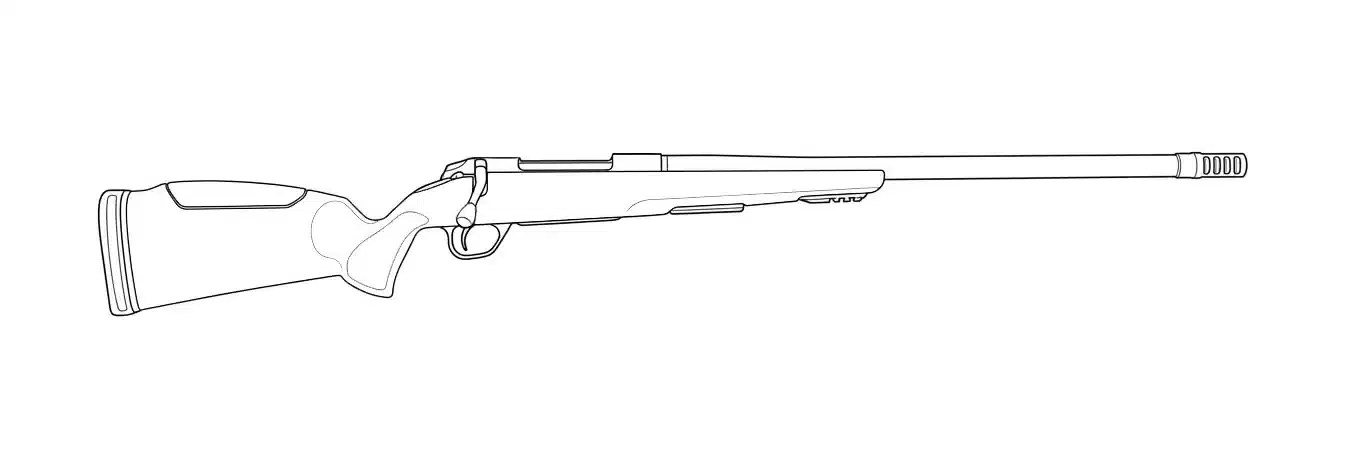
Fierce builds the 25 Creedmoor across the lineup, from featherweight backcountry rifles to precision-hunter platforms — every one hand-assembled in the USA and guaranteed to shoot.
- Fierce Carbon Rogue: C3 carbon-wrapped barrel, carbon stock, Trigger Tech adjustable trigger, and the Fierce 700-pattern action. A light, sub-MOA-guaranteed hunting rifle that fits the 25 CM perfectly for Western big game.
- Fierce MTN Reaper 2.0: the dedicated mountain-hunting in our folding, lightweight chassis platform, built around weight and balance for the long, deliberate shots that define alpine hunting.
- Fierce Rival Models: Available in Carbon, CT (Carbon Barrel and Titanium Action), and Twisted Rival (Twisted/fluted steel barrel) configurations for shooters who want to tailor barrel and finish.
- Build Your Own Fierce Rifle: Yiu spec barrel material, length, contour, stock, trigger, finish, and optic, delivered direct from the Redmond, Utah factory.
At Fierce, we have the 25 Creedmoor build you are looking for, made by outdoorsman, like you, with delivery direct from our Redmond, Utah factory.
25 Creedmoor Frequently Asked Questions
Is the 25 Creedmoor SAAMI approved?
Yes. The 25 Creedmoor was SAAMI-standardized in January 2025, making factory ammunition and standardized chambers widely available.
What is the 25 Creedmoor good for?
Deer, antelope, hogs, and predators out to about 600 yards, and target shooting well past 1,000 yards. It’s a strong choice for Western hunters and dual-purpose hunt/range rifles.
What is the 25 Creedmoor’s effective range?
It retains 1,000+ ft-lb of energy past 600 yards — the common ethical threshold for deer-sized game — so ~600 yards is a practical maximum hunting range, while target shooters run it to 1,000+ yards.
How much barrel life does a 25 Creedmoor have?
Comparable to the 6.5 Creedmoor and longer than overbore 6mm cartridges, because it uses a moderate-capacity case that’s easy on throats.
25 Creedmoor vs 6.5 Creedmoor — which is better?
Same case; the 6.5 offers heavier bullets and slightly more long-range energy, while the 25 Creedmoor recoils about 10% less and shoots flat at mid-range. Choose based on whether you prioritize bullet selection (6.5) or recoil and spotting (25).
hat twist rate does the 25 Creedmoor use?
The SAAMI-spec twist is 1:7.5″, fast enough to stabilize heavy, high-BC .257 bullets that a standard 1:10″ .25-06 cannot.